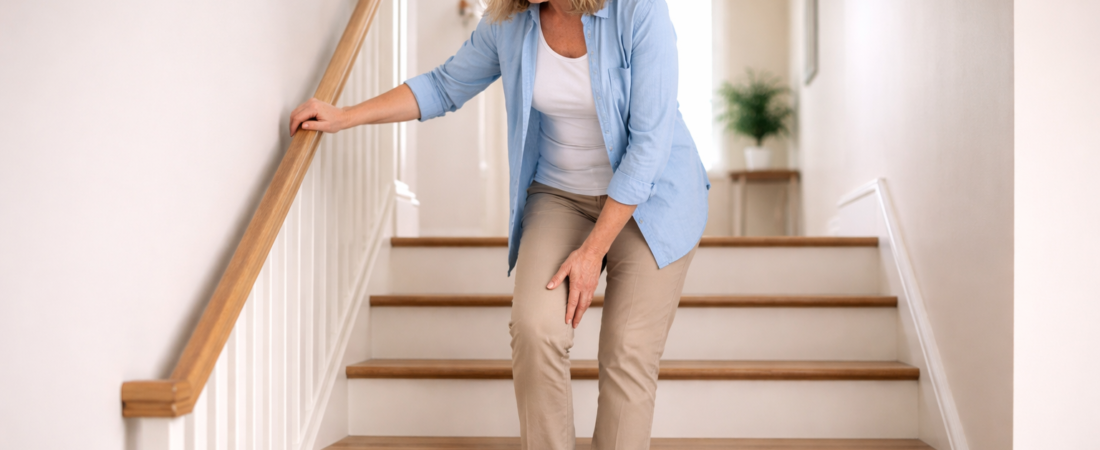
If your knee feels fine on flat ground but hurts when you use stairs, the extra load placed on the joint is usually the reason.
Stairs demand more bending, more force, and more control than level walking. That difference can expose problems that do not show up during normal movement.
Why Stairs Stress the Knee More Than Walking
When you walk on flat ground, your knee bends slightly and carries your body weight in a steady rhythm.
When you climb stairs:
-
The knee bends deeper
-
The muscles around the knee work harder
-
The kneecap presses more firmly against the joint
-
Your body weight shifts upward or downward
Going down stairs can place even more pressure through the front of the knee because your muscles are controlling your body as it lowers.
If a structure inside the knee is irritated, stairs may reveal it while walking does not.
Common Reasons This Happens
Several conditions tend to cause pain on stairs but not during normal walking.
Patellofemoral (Front of Knee) Pain
Pain around or behind the kneecap is one of the most common reasons for stair discomfort.
This pain often:
-
Feels worse going down stairs
-
Feels sharp or aching at the front of the knee
-
Improves on flat ground
The deeper bend on stairs increases pressure between the kneecap and the thigh bone.
Early Cartilage Wear
Mild joint surface wear may not hurt during light activity.
Stairs increase compression inside the joint. That added load can trigger discomfort even when regular walking feels normal.
Muscle Imbalance or Weakness
The thigh and hip muscles help control the knee during stair use.
If they are not supporting the joint well, the knee may feel strained only when the demand increases — such as climbing or descending stairs.
Tendon Irritation
Tendons around the knee can become sensitive with repeated use.
Flat walking may not trigger symptoms, but pushing upward on stairs can.
Why Going Down Often Hurts More
Descending stairs requires controlled lowering.
Your muscles are working to slow your body weight. This increases pressure through the knee joint.
If your pain is worse going down than going up, that pattern can help narrow the likely cause.
You can read more about how direction changes the load in Knee Pain Going Down Stairs.
When This Pattern Is Common
People often notice this symptom:
-
After increasing activity
-
After long periods of sitting
-
During midlife and later years
-
When returning to movement after a break
The key feature is consistency:
Walking feels fine.
Stairs trigger pain.
Simple Things People Try First
If pain is mild and recent, people commonly:
-
Slow their stair pace
-
Use a handrail for support
-
Step up one step at a time
-
Reduce repeated stair use temporarily
If discomfort continues, gentle strengthening and control exercises are sometimes explored.
When to Consider Further Evaluation
If pain:
-
Persists for several weeks
-
Becomes sharper or more frequent
-
Causes instability
-
Appears with swelling
It may be appropriate to consider medical advice.
The Bottom Line
Knee pain that appears on stairs but not walking usually reflects increased joint load rather than a sudden injury.
Stairs demand more from the knee.
Walking does not.
Understanding that difference helps narrow the cause and decide next steps calmly.
If you want a broader overview of why stair use triggers knee discomfort differently from flat walking, see Knee Pain on Stairs.